Saturday, March 5, 2011

You've Got to Serve Somebody


Bankei Yotaku (1622-1693), Sakyamuni and Maitreya, ink on paper, 11 1/4x221/4", private collection.  Image courtesy of Stephen Addiss and Audrey Yoshiko Seo.

By Hozan Alan Senauke

Zen Master Bankei’s enso is completely his own.  So graceful and strong.  Usually the enso is one circular stroke, perfectly imperfect, expressing the wholeness of existence, which is peace. Emptiness is encircled by action.  Although enso is beyond words, the Zen poet often includes a verse as commentary.  In this case Bankei writes: “Sakyamuni and Maitreya are both servants.” 

In The Art of Zen Stephen Addiss writes about this particular enso:
Bankei, ever the individualist, used two strokes, each strongly and quickly articulated.  The effect is to give an entirely new meaning to the form; the strokes enclose each other like an embrace yet still suggest both emptiness and completeness.*
Addiss explains that Bankei’s commentary — “Sakyamuni and Maitreya are both servants.”  — refers to case 45 of the classic koan collection, the Mumonkan which says: “Even Sakyamuni and Maitreya are servants of someone else. I ask you: whom?”

Whom?  I cannot answer, but there is power in the two embracing strokes that create this circle, with emptiness at its heart. Two lines, two actions, each with its own energy and boundary, come together as one circle. This, for me is the image of peace, not a false merging like peoples fighting for domination, or nations created by the stroke of a pen at gunpoint, but a dynamic mutual relationship.  Rev. Martin Luther King called this relationship “the beloved community.”  There will naturally be conflicts in the beloved community. Conflict is human. In the beloved community, however, conflict is not resolved by threats or violence, but by persistently turning toward each other. Many ensos have a small gap at the end of a single brush stroke. The gap embodies beginning and end. Conflict is implicit, but it is just part of the story. Here Bankei uses two strokes in two directions, interlocking like yin and yang, reaching out for completion.

Coming back to the koan, Sakyamuni is the embodied Buddha of our age and place.  The time is this present eon. The place is the Saha world we inhabit.  Saha means the world that is to be endured. When he woke up under the bodhi tree Sakayamuni declared: “Now I am enlightened together with all beings.”  All beings were his servant and he is servant to all beings. The power of this koan, and of Bankei’s enso is that this is undeniably true for us…each of us. We are servant and we are served.  All life is a circle of giving.

As for Maitreya Buddha, she is currently teaching in Tusita Heaven, a pure Buddhaland beyond our comprehension. She is destined to be the future Buddha of our world. Something like a messiah. When will she arrive?  Are we ready?  Do we deserve her presence? Will it be a new millennium?  Driving into Oakland from Berkeley the other day, I saw a billboard: Judgment Day — May 21st, 2011.  Guess I had better get prepared.

Maybe Maitreya is already here.  Maybe Maitreya is you.  Or me. Servant and the served, host and guest are not separate.  They co-create each other in the circular activity of giving. This is a fine idea. But if it is just an idea, the circle is broken. Keep it real. Who is serving you?  Who are you serving? Such questions…this is the work of peace. 


Alan Senauke is here standing beside a painting by Max Gimblett, at the time on view in the Sweetcake Enso exhibit at the Brooklyn Zen Center, and which later sold to raise money for the Village Zendo.**  Alan Senauke is the author of the beautifully written book The Bodhisattva's Embrace:  Dispatches from Engaged Buddhism's Front Lines.  Recently he became a Buddhist blogger - currently travelling in India, you can read of Hozan Alan Senauke's wanderings at the

***

*  Stephen Addiss, The Art of Zen, NY: Abrams, 1989.  See also Audrey Yoshiko Seo,  Enso:  Zen Circles of Enlightenment, Boston and London: Weatherhill Press, c. 2007.
** Photo by Ian Case of the Brooklyn Zen Center.

Monday, February 7, 2011

Peace, the Perpetual Problem


By Jeanna Annen Moyer


Editor's note:  The above photograph is of one of the Perpetual Peace Project installations at the New Museum, in the context of their now past exhibit Free.  The Perpetual Peace Project is "predicated on the belief that no one institution or individual can clearly claim or guarantee a mastery of the concept of peace," and aims at understanding peace beyond its being merely the absence of war. With the blue circle as the design platform, scattered throughout the New Museum were kiosks featuring interviews with scholars such as Helene Cixous and Saskia Sassen in response to Immanuel Kant's 1795 essay "Perpetual Peace."  There are a downloadable copy of the essay and video clips on the Perpetual Peace Project website link above.  With the premise that the Perpetual Peace Project has now entered the public commons, what follows is a short essay by Jeanna Annen Moyer, a member of the Dharma Rain Zen Center.

***

I consider myself to be a recovering academic. Part of the move to Zen practice for me has been about moving away from intellectualizing my experience and moving toward engaging it directly, without a complicated array of concepts and analysis between me and it. I’ve  wanted to put the conceptual apparatus down, and inhabit my life with both body and mind, with fresh eyes. Consequently, I was conflicted when asked if I’d be interested in commenting on Kant’s essay on Perpetual Peace from a Zen perspective. I’ve resisted the scholarly study of Zen in favor of embodied practices like zazen, walking mediation, and work practice. I’ve felt that the last thing that would support balance in my life was more scholarly study. So, the following is a departure for me: writing on a scholarly topic from the personal perspective of my Zen practice.

Re-reading Kant’s essay on Perpetual Peace felt like going home to a family gathering filled with  old, dysfunctional dynamics.  The veneration of reason over emotion, the insistence on duty over all other considerations, the idea that humans must in some sense be coerced in order to act morally-- an old, familiar song. And yet, given Kant’s rather dim view of human nature, the upshot of this essay is quite hopeful: That perpetual peace among people is both logically and practically possible. This is partly based on well-worn  social contract theory arguments that we are all better off if we band together to better serve our selfish interests.  Just as individuals are better off banding together and agreeing to respect each others’ rights, the same is true of nations. And so a federation of nations should be formed, to ensure that each nation respects the rights of others. Kant says that nature has purposively designed  the world so that humans can and should live everywhere in it, and thus made war the natural means of resolving the inevitable conflicts that arise. It is in people’s  mutual interest to unite against war (refer to the First Supplement, "Of the Guarantee of Perpetual Peace," pp. 25-34, found in the document available here by clicking on the title of Kant's essay.).

Although Kant was writing to show that lasting peace among nations was at least theoretically possible, it’s interesting how much of his essay foreshadows actual developments in world politics. For instance, Kant wrote of the desirability of forming of an international federation of nations aimed at preserving the rights of all. He wrote of the dangers of time-honored political tactics that are still with us today : “…if it be a question about other States, then exciting of suspicion and disagreement among them, is a pretty safe means of subjecting them to yourself, one after the other, under the pretence of assisting the weaker." (p. 44 of the online version.). And writing during the time of Frederick the Great, Kant described the benefits of federalism, now the mode of government in what was Prussia.

Despite Kant’s lofty statements on the power of human reason, he seems to have a fairly pithy perception of politics, shown in a statement that could be used to describe some current situations: “…[men in politics] allow all proper honor to this conception [of public right], although they may have to devise a hundred evasions and palliations in order to escape from it in practice...” (p. 45 of the online version.) In addition to a realistic grasp of the machinations of politics, Kant also seems to have been gifted with some foresight about developments to come.

If Kant was right about some other things, what about lasting international peace? Many nations have developed federalist or federalist-type governments; international organizations aimed (at least in theory) at the common good have been formed; and at least the concept of international right is widely accepted. Why hasn’t lasting peace followed? To get a sense of the number of armed conflicts currently occurring, try an internet search on: How many wars in the world today? Or see this link. War seems to be a constant, rather than peace. Is there anything in Kant’s essay that can help us understand why?

From a Zen perspective, there was one section of Kant’s essay that caught my attention.

Now it is admitted that the voluntary determination of all individual men to live under a legal constitution according to principles of liberty, when viewed as a distributive unity made up of the wills of all, is not sufficient to attain [Perpetual Peace], but all must will the realization of this condition through the collective unity of their united wills, in order that the solution of so difficult a problem may be attained, for such a collective unity is required in order that civil society may take form as a whole.  Further, a uniting cause must supervene upon this diversity in the particular wills of all, in order to educe such a common will from them, as they could not individually attain.  Hence, in the realization of that idea in practice, no other beginning of a social state of right can be reckoned upon, than one that is brought about by force; and upon such compulsion, Public Right is afterwards founded.  (italics added, from p. 38 of the online version.).

The idea that public right, a necessary precondition for international right, can only be established through coercion is, from my perspective, a fatal flaw in a system intended to yield lasting peace. Coercion, whether by reason, fellow citizens, or politicians, is a kind of violence, and can only breed further coercion. This is true of federalist, communist, or any other kind of political system. If we start with coercion, we should not be surprised when further coercion, conflict, and war results.

So, what is the Zen answer to achieving perpetual peace between nations? Kant would be disgusted, but this is a point on which I can’t contribute a theory, only my experience. In my opinion, international peace can only sprout from peace among individuals. Peace for me has arisen from turning toward my experience and learning to accept it unconditionally, with an open heart. As my practice in this regard has deepened, an abiding compassion for others has naturally arisen—a compassion that encompasses regard for others, a concern for their well-being, and a growing recognition that my well-being cannot be separated from theirs.

The delusion that we are disconnected from others, that our well-being is separate from theirs—in my opinion that is the true root of war. And so, an approach that presupposes this cannot be a foundation for lasting peace. It is not reason, still less coercion, that provides a sustainable way out of war. It is awakening compassion, and coming to understand that others’ well-being is inseparable from our own. This might seem to be a variation on the theme of avoiding war because it is in our own self-interest. But the deeper point here is that it is not for simply for ourselves, but out of authentic compassion for others that war becomes unacceptable. To put this in other, famous words, “Hatred never ceases by hatred, but by love alone is healed. This is an ancient and eternal law.”


Monday, January 31, 2011

Dermot Mac Cormack: Untitled #11


Dermot Mac Cormack, Untitled #11, 2011, audio Priests, Monks and Pilgrims of Kyoto, reissued by lyrichord discs. Dermot Mac Cormack is an associate Professor at the Tyler School of Art, the creative director of 21xdesign, and a student of Shuzen Sensei at the Soji Zen Center.

Wednesday, January 26, 2011

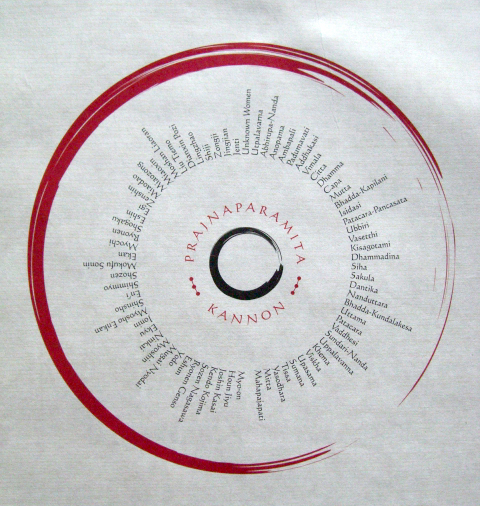
Women's Lineage Papers


By Peter Levitt

As part of a concerted effort undertaken by certain North American Zen communities to redress a significant historical wrong, this was among the first lineage papers in Buddhist history that acknowledges and honours Buddhist women ancestors.  Relying on years of research, performed mostly by women scholars in the academic world, it was created on behalf of the Salt Spring Zen Circle in British Columbia through the efforts of Zen teachers Zoketsu Norman Fischer of Everyday Zen and Eihei Peter Levitt of the Salt Spring Zen Circle.  It was designed by Barbara Cooper from Los Angeles.  In November 2007, on Salt Spring Island, male and female students of these two teachers were given this women’s lineage paper as part of their lay ordination ceremony, thus helping to end an overwhelming historical silence regarding women ancestors in Zen. The women’s lineage paper was bundled together with the male lineage paper traditionally given at this ceremony, and the two papers were received by the ordainees together.


The wheel of women ancestor names begins with the name of Shakyamuni Buddha’s mother, Mahapajapati, at the bottom, just to the right of the space at what would be the six o’clock position.  The names then ascend in a counterclockwise direction.  Names of women ancestors from India, are followed by ancestor names from China, Japan, and North America.  Of note is that at the top of the enso, in what would be the twelve o’clock position, the words “unknown women” appear.  This is to acknowledge the countless women whose sincere practice helped to nourish Zen and Buddhism throughout history but whose names, for a variety of reasons, were forgotten, suppressed, or left unsaid.


At the bottom of the wheel a blank space was left so that each new ordainee could have their name written in, and thereby be embraced by the ancestors.

***

Alongside his work as a Zen teacher, Peter Levitt is an accomplished poet, and most recently published Within Within. You can visit his website here, and you can contact Peter Levitt directly at his email address, levgram[at]gmail.com.

Monday, January 10, 2011

Sweetcake Enso opens at the Village Zendo this Saturday, January 15th!


Maria Wallace, Supercell, oil on canvas, 18x14", 2010

With ten new artists on board, Sweetcake Enso is on exhibit for one day at the Village Zendo this coming Saturday. Sweetcake Enso draws attention to the abstract circle as a symbol of presentness in daily life, and opens out the traditional calligraphy of the Enso to include the work, unlimited by media or training, of contemporary artists involved in strong Buddhist practice. Without motivation to define “Zen Art,” the interest here is in a shift from the monastic practice of Japan to a stronger emphasis upon lay practice in American Zen, and what this means for understanding contemporary art as Zen practice.   From cyclone to stillness, these works are individual offerings to the teachers that are with us now and who have come before.  In this exhibit sales will benefit the Village Zendo, and be met by a matching grant in honor of their 25th anniversary.


Emma Tapley, Water Reflection/Landscape Inversion, C-print, edition of 5

The third Sweetcake Enso exhibit opens Saturday, January 15th at the Village Zendo, 588 Broadway, suite 1108.  Viewing is from 11:00-7:00, followed by a panel discussion from 7:00-900 pm.  Artists in the exhibit are:  

Miya Ando, Sanford Biggers, Ross Bleckner, Sam Clayton, Robyn Ellenbogen, Noah Fischer, Carolyn Fuchs, Max Gimblett, Rodney Alan Greenblat, Gregg Hill, Anne Humanfeld, Phyllis Joyner, Erin Koch, Liz LaBella, Peter Levitt, Timothy Reynolds, Karen Schiff, Fran Shalom, Bridget Spaeth, Emma Tapley, Leslie Wagner, Maria Wallace, Maggie Wells and Michael Wenger.

Please join us at 7:00 pm for a lively discussion of how Buddhist practice inspires and informs contemporary art.  Panelists include:

Max Gimblett, artist teacher and lecturer
Emma Tapley, artist
Rodney Greenblat, artist
Robyn Ellenbogen, artist and art editor of Zen Monster
Catherine Spaeth, art historian and curator
Ross Bleckner, Four Locations, color spitbyte aquatint with chine colle, 39x30" 2007