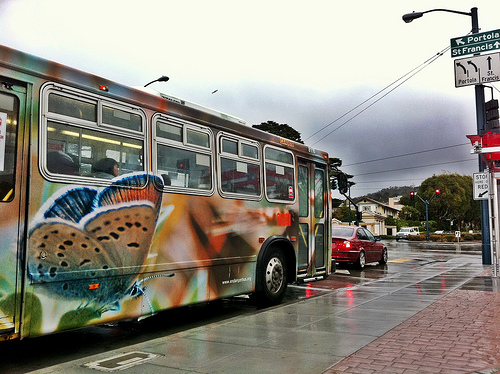
Todd Gilens, data points for Butterflybus, January through March, 2011, with thanks to Eric Fischer.
Since mid-January four city buses dedicated to threatened wildlife in the San Francisco Bay Area have been making their rounds. The following interview is with Todd Gilens, the artist who made possible the Endangered Species mass transit project. Todd exhibited in the fourth Sweetcake Enso exhibit, at the San Francisco Zen Center.
Catherine Spaeth: You have an ear for making a strong pitch that is taken up with interest, a design sensibility that is much more drawn to community discourses. In your own writings there is an expression of your interest to step outside of the white walls of an art context and out into the context of community. The skill of negotiating with administrations and being able to convey to them the possibilities of something that has not been realized, this is a pretty explicit skill to have. At MTA here in New York it is just not easy to get your voice into those projects.
Todd Gilens: The process of selling an idea is definitely part of the work, to bring people into the idea. They wouldn’t normally encounter this idea in the course of their day, so I am noticing something, some potential, and I’m coming to them and saying, well what would it be like if we look at it this way? I’m giving them that opportunity to really turn their perspective around on something that is a part of their everyday life.
CS: The realization of the project itself is really quite shortlived, I understand there are five buswraps, the San Francisco Garter Snake, the Brown Pelican, the Coho Salmon, the Mission Butterfly, and the Salt Marsh Harvest Mouse, and they have been moving about since mid-January and will be removed soon?
Todd Gilens, Snakebus (photomontage)
TG: Actually four buses were done. The snake bus didn’t get wrapped, it was part of the original plan but there was a funding shortfall and I had to decide, what are the four strongest images? the problem of designing for buses is that they are a very long rectangles and with all of the images but for the pelicans a part of the animal image would be cut off. The snake had this wonderful snaky line that went along the bottom of the bus and up to the top of the windows.If you take a chunk out of the snake it really impedes the sense of animal motion but you can take a chunk out of another animal and your eye completes the image. I was disappointed in some ways because the San Francisco Garter Snake is really beautiful and it also presented the most challenging image.
CS: From the picture on the snake bus it was quite visually dynamic, it wasn’t only the snake it was the sharp spiky grass that was cruising down the street, not softened by the colors of wildflowers or the blue of the ocean, and it had a texture that sprang out from the telephone poles and the whatnots of an urban environment in a really interesting way. I too am now disappointed that the snake didn’t make it.
This is the vulnerability of projects such as this to things such as funding and politics.
In New York City the shuttle from Grand Central to Times Square is a huge bit of mass transportation, and the advertising skins are both inside and outside. They have a very short life, because the advertising is so high profile, so massive. Recently this was only to advertise Lady Gaga’s album. It was to arrive in only a few days, the date was planted all over the bus. (It is interesting to note as an aside that this was the same week that the world was to end according to God’s plan, and pamphlets were being handed out only a few feet away.) The life span of those advertising wraps is incredibly short, you are surrounded inside and outside by an outrageous consumerism. In reading the language around it, I discovered they call it “Upmarket graffiti,” that kind of bus wrapping, have you heard that before?
TG: No, there’s another one here though, advertising contractors call it wild wrap, not the conventional wrap placement but pasted here or there. I actually haven’t seen it done, perhaps between the design houses’ profit margins and the transit authority’s review process there is just too much uncertainty. Advertising is a transit subsidy and transit all over the country is running huge deficits, so it’s quite a pickle if you want to take public transit space back from the corporate interests. The question for me is: how do these images contribute to how we imagine ourselves into the world – and what kinds of relationships are then nourished on that.
CS: What is amazing about the term “upmarket graffiti” is the seizing upon street cred, and certainly this notion of the wild comes back full swing – your own work really starts with graffiti, I was looking at your birds in the Philadelphia brewery, the Four Stories Man, the bird shadows in the ground, there is a definite sense of the mark in public space that appears to be a beginning not the beginning, but the departure that brings you to this place, to a stronger interest in engaging with public spaces in order to frame a kind of discourse. These have been, some of them, really quite temporary. The self-portrait deck of cards is another expression of impermanence.
Todd Gilens, Prototype, for more information please visit the artist's website, here.
With regard to the buses it strikes me that the amount of time that it takes to generate the idea and realize it and the amount of time that is actually out there in the world are quite different senses of time.
You make a comment in the article (
available here) on the
Endangered Species project that you wrote for Antenna: The Journal of Nature in Visual Culture about not allowing the buses to become prescriptive, there is something about the temporary nature of these buswraps that you enjoy. This is very much involved with the notion of beauty that you describe as something that holds contradictions but that is also a generative transformer. You write:
Beauty is a powerful force, directed toward stilling, openness and ambiguity. These qualities also describe a relationship to nature at its most essential: wonder, awe, an unsettling, diffident attraction, a feeling that the things in the world exceed our capacity for understanding, knowledge and cognition. Such beauty is able to contain contradictions, to delicately hold together contrarieties without resolution. Beauty is a method that both art and nature wield. It is a generative transformer. Image, symbol, can change minds but not determine them.
What beauty does is not have any claim to an idea but to disperse itself into the world as a variety of provisional experiences, taking in that beauty without any one claim on it. Beauty can’t change minds or determine them, but people will soak it up with all their provisional views and are nonetheless transformed by it.
There is in this project a lovely movement from your own private research towards a pitch moving through a bureaucracy, and then letting loose these beautiful things upon the city with no prescriptive intention but for how they affect people in myriad ways, always from their different perspectives turning to face the environment they are in. That’s a very lovely movement, lovely passages through all these different moments - idea – pitch – letting loose the realization, aspects of an action in the course of its effects.
TG: Yeah it’s a complex process, layered. I also notice and think about a fractal or nested structure in the work, meaning that a relationship at one scale manifests, transformed at another. For example, the images look realistic from a distance but up close are very grainy. At another level there are personal and collective needs; the collective picture is made of all the personal ones but forms it’s own sense and pattern, yet they are the same thing.
Photo courtesy of the artist.
CS: Did it feel rather fluid to you that from these buses you then were able to move to the next project, which is the aquarium?
TG: The aquarium is a new project, I don’t have too much to say at this point because I’m still working out the framework for it, administratively, but from my point of view an urban space is a busy noisy environment; the aquarium is sort of turning that upside down, it’s an underwater world of tunnels, where the fish swim over you, you’re really dealing with the fishes’ world.
CS: So the opposite of the buswrap, the same tube feeling but…
TG: The bus wraps are reintroducing the species to the people and their habitats that displaced them. This is a borrowing from restoration ecology, bringing things back. The aquarium is a hybrid situation because it is an aquarium, it’s not like people are going into a tunnel into the bay. The fish and their water are brought onto land where people can meet them. I suppose it’s a bit like what the animal-buses are doing: bringing animal experiences, which we have pushed to the margins, closer to ourselves.
CS: Is there overlap between these two projects or was it in the course of doing business that these two different projects occurred simultaneously?
TG: Well once you have a contact of some kind, even if it is only visual or through photography, something more can happen. One of the pivots between the two projects is to look a bit at things from the animals’ points of view. As far as the project origins, there is a member organization called
SPUR - the San Francisco Planning and Urban Research Association, and I’m a member, and they do advocacy and research work around urban development issues. They came out in the late ‘50s as housing advocates, but now have a much broader purview. At lunchtime forums they discuss different issues around the city and in 2007 they were discussing transportation, which is where the bus wrap idea got going for me. They organized a visit to the aquarium last fall, a behind the scenes tour. I had never been before and I thought the institution of an aquarium of rather dull-looking but amazing fish – our neighbors - and especially the feeling of being transported to an underwater world, was very potent. I grew up keeping fish in an aquarium and at one point I thought I would become an oceanographer, so that’s how that started, I was in a position to learn these things about the city – not just what humans are doing but the whole bundle.

Todd Gilens, Human Beans, for more information visit the artist's website, here.
CS: In thinking of your work in relation to Buddhist practice I notice that on your website
you describe a primordial place before evolution where species and stages haven’t yet arrived, where “language ate at the table of landscape.” For someone who meditates this is not at all difficult to understand as a place without distinction, accessible in that sitting practice. Do you make the connection yourself in your work, the connection with the environment around you and the social spaces that have already sort of fit themselves in and through to the extent of having an underwater tunnel where we can join the fish, is that at all something that you would want to say is supplemented – not generated by but somehow informed by – another part of your life which is your practice as a Buddhist?
TG: Yes, definitely. I think of meditation practice and Buddhist studies and whatever might define a Buddhist lifestyle if you like, and my art practice, as being complementary, almost in the sense of a relationship, as in the other kind of compliment: , “Oh, you’re doing so well!”. My art practice really is about testing out the dynamics of experience. How do things seem real? How do they relate to each other? How do they change? Buddhism has a lot to say on these themes; my work is where I can explore them in my own way, through my own history and opportunities.
CS: Is there anything that you want to say or to add to what we’ve already said?
TG: Yes there are some things I’d like to go back to - one is the timing of the buses. Something that interests me in working outside the studio, out in the social spaces, is the interaction of the work with the environment. But saying it that way is a little misleading because the intervention and the environment together are the work. And so in relation to the end of the project what is meaningful there is that the animals will be let’s say extincted, as a demand for advertising increases. And so I think we can all understand that relationship of commerce overriding environmental concerns as a microcosm of a familiar process.
Todd Gilens, Four Stories Man, for more information visit the artist's website, here.
CS: This is also something that happened with the Four Stories Man, it was your intention that the demolition of the building is being framed by the work and so what you’re saying here is well, it’s nice to wish that we can always have them but the fact is that we can’t and it becomes an almost more political statement to face the end of the work as an important event.
TG: It’s a recognition of transitoriness, but also what that does to our relationship in the unstable present, it provokes a certain kind of attention. And then there are the records, the photographs, which for me have been very important. They are the magical rear-view mirrors, through which we both access, and sense our separation from, what is gone. It’s a remarkable contradiction to consider and the photographs, because they are stable moments, allow us to return again and again to that separation.
Another thing I’d like to expand on is the idea between the work and public space. In the late 70’s I began putting things around and letting everyday life act on them, doing things like transplanting other people’s garbage from one city to another, in gestures they weren’t visible, as invisible as one can imagine, secret tiny shifts in the relationships of humans and landscape. My work goes back and forth between the studio and the rest of the world. I came to understand this poverty of my own process. Working in a derelict, abandoned brewery, which was also being used for the adventures of neighborhood kids, using that as a canvas, was so much richer than anything I had experienced in the isolation of the studio. I began to recognize my own limitations and that I needed this dialogue with the process that is going on around me.
Todd Gilens, Urban Birds, for more information visit the artist's website, here.
CS: It’s a huge jump from working in the private spaces, still, of an abandoned brewery and negotiating with a city transit system. The step you are describing while it felt big at the time has incrementally expanded to the nth degree. I was speaking with another artist recently who was able to address large historical situations as somehow corresponding with his own developmental maturity in time, responding to history in terms of a similar kind of growing expansiveness. You’ve always been interested in nature and the environment, but have you seen some kind of a connection to systemic changes in the world that you felt the need to respond to and there was a happy marriage of skills in accord with these changes?
TG: Like what systemic changes?
CS: For example, in our own lifetime responses to the environment as an issue have changed considerably. I don’t think that mass transportation was considered to be a response to the environment so much as an economic social need, the practical matter of getting workers from one place to another who couldn’t afford cars, in an economy that was dependent on them. The new interest in mass transit as a way to protect the environment would be an example of a shift that is historically finding itself outside of your own agency but nonetheless your skills bleed into that change and interest. That’s one example that I can think of, might there be another instance, where there was a readiness in the world and your skills showed up in that readiness?
Photo courtesy of the artist.
TG: Yes, certainly the problem is to match what one has, one’s abilities and predilections, with the historical conditions. And hopefully also to grow together. This is always a struggle and perhaps at the center for most creative work. The world and my practice is one of bonding, of noticing and responding. And so in Philadelphia in the 1980’s I was noticing the quality of the abandoned factory buildings, which was also the space I was living and working in. I wondered how did we get to this urban landscape full of empty manufacturing places, what is the meaning of these buildings? And couldn’t that meaning be shown at some depth? And so “Urban Birds” came through that process., There was a period of research, a search for an appropriate site, and tracking down the owners – which can be difficult on derelict property. “Urban Birds” also turned out to be a four-year project. Working with the owners on the one building that it finally happened in became a warm up for the San Francisco Transit Authority. When I moved to the Bay Area in 2002, the natural environment was clearly a dominant aspect of the culture, just as the post-manufacturing landscape of Philadelphia had been twenty years before.
CS: One of the things at stake in the difference between the studio practice that you describe as having left behind and what you do now, is that there’s a kind of readiness and responsiveness that inspires you in your environmental situation and that’s what compels your work.
TG: My model or my framework of the process is a dialogue with what’s happening. It’s much more interesting and gratifying to work on the canvas of a municipal transit system than a sheet of fine paper, though paper does have its advantages. Also maybe I’m a bit of a literal person: if I want to say something about buses, I need actual buses to say it with. But I think there’s also a risk of making work that becomes too topical. One of the things I try to reach in the opportunity of art-making is for the work to settle down at a primordial or fundamental level, that a hundred or two hundred years from now, five hundred years from now, will still have resonance. It matters less that the work lasts that long, as that it speaks to those parts of us, the parts that are durable to that degree.
CS: One of the things that prevents the buses from feeling topical though is how they are moving about in lived space, people are looking for them as they go by, there is a twitter feed, “I just saw the Coho Salmon!,” so there is a mobility in actually lived life that is preventing them from hitting you on the head with a political statement, which would be the fear of an overdetermined topical work.
TG: There are other things too that I think of more as the refinements of the project. There’s layers in the projects that have to do with color, for each of the buses there is a dominant color and each of the buses corresponds with each of the four elements; the representation of five classes of animals; and the subtle ways they function in relation to the openings of the bus doors and windows. At this point the project may be too fresh for me to understand any claim to timelessness or timeless beauty, but my intention is to refine it as best I can. And there is this process to notice and to look at layer after layer after layer. Maybe that’s where the public interactions you are speaking of come in. The project is open; it’s mine, but it doesn’t belong to me. It’s made by the people who see it or know of it.
CS: From the beginning of the project to now has there been a new insight that has changed the import of this for you? Your understanding of what it is?
TG: What I can say about that is that it is astonishingly complex to have the buses out there and to realize the difficulties of every day life on the street in terms of our attention. In terms of what we let in and what we keep outside.
A part of the fun is that bus riders and pedestrians are connected to this project by a twitter feed, and photographs are being submitted to the website. Here is a photograph of the Mission Butterfly taken by Anthony Brown, found here.
CS: So the complexity isn’t only a thickening up of meaning it’s equally a loss of meaning, a missing?
TG: I’m not sure where meaning goes. I think resistance, if that’s part of what is going on, is still a patterned process, a meaningful one. A lot of people have worked hard to unpack the experience of every day life, urban life in particular, the complexities of ‘What is public space and how does it function?” That is one of the limits this project is hitting, in the way that a geologist can strike a rock with a hammer to understand it’s qualities.
CS: Using the buses then as a measure of what makes public space, what is public space, is not ascertainable.
TG: There’s much we can’t answer, but we can still get a lot of information. Hitting a wall means we can’t go any further. But that collision provides information and does allow us to go further, or perhaps to transform the question entirely. The problem is to keep both: knowing and not knowing. We are so intent always on utility and solving problems, but there are other possibilities. What is a tiny butterfly or rare mouse to an ecosystem? It seems, almost nothing; but there they are!
Photograph courtesy of the artist.